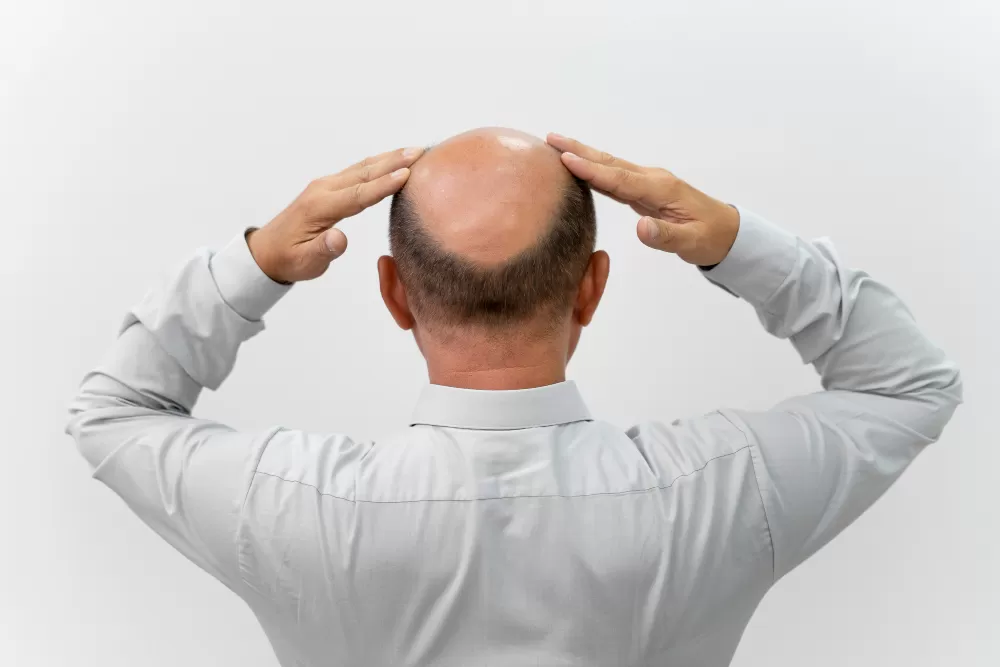
Male pattern baldness (androgenetic alopecia) is the most common type of hair loss in men. It occurs due to a combination of genetic predisposition and the effects of the male hormone dihydrotestosterone (DHT). Over time, DHT causes hair follicles to shrink, producing thinner, shorter hairs until the follicles eventually stop producing new hair altogether.
Typically, it starts with a receding hairline and thinning at the crown. As the condition progresses, these areas may merge, leaving a bald region on the top of the scalp while hair remains on the sides and back.
Symptoms of Male Pattern Baldness
Male pattern baldness develops gradually and often goes unnoticed in the early stages. Common signs include:
Receding hairline: Hair begins to thin around the temples, forming an “M” shape.
Thinning at the crown: The hair on top of the head becomes sparse or patchy.
Thinner hair strands: Hair loses its density and strength over time.
Miniaturized follicles: Hairs become softer and shorter before the follicles close completely.
Symptoms may begin in the late teens or early twenties, but the condition typically becomes more visible in the 30s and 40s.
Causes of Male Pattern Baldness
The main causes of male pattern baldness are genetic factors and hormonal changes, although lifestyle and age can also play supporting roles.
1. Genetic Factors
Family history plays a significant role. If male relatives experience baldness, there is a higher chance of inheriting hair follicles sensitive to DHT.
2. Hormonal Influence
Testosterone converts into dihydrotestosterone (DHT), which binds to hair follicle receptors. Over time, this interaction weakens the follicles and shortens the hair growth cycle.
3. Aging
As men age, hair growth slows naturally, and the follicles become less active, contributing to progressive hair loss.
4. Stress and Poor Lifestyle
While not a direct cause, stress, sleep deprivation, and poor nutrition can worsen hair thinning or accelerate the progression of baldness.
Stages of Male Pattern Baldness
The progression of male pattern baldness is classified using the Hamilton-Norwood Scale, which outlines its seven stages:
Stage 1: Minimal or no hairline recession.
Stage 2: Noticeable recession at the temples.
Stage 3: Deepening of the hairline and beginning of crown thinning.
Stage 4: Hair loss on the crown and temples becomes more pronounced.
Stage 5-7: Bald areas merge, leaving only hair on the sides and back of the head.
The rate of progression varies from person to person — for some, it may take decades, while for others, it advances more rapidly.
Treatment Options for Male Pattern Baldness
Although male pattern baldness cannot always be completely stopped, early intervention can slow progression and stimulate regrowth in some cases.
1. Medications
Minoxidil: A topical solution that stimulates blood flow to hair follicles, promoting growth.
Finasteride: An oral medication that reduces DHT levels, slowing down hair loss.
2. PRP (Platelet-Rich Plasma) Therapy
Involves injecting platelet-rich plasma derived from the patient’s own blood into the scalp to rejuvenate hair follicles and encourage growth.
3. Mesotherapy
A mixture of vitamins, minerals, and amino acids is injected directly into the scalp to nourish and strengthen hair roots.
4. Hair Transplant
For advanced cases, hair transplantation offers a permanent solution. Techniques like FUE (Follicular Unit Extraction) and DHI (Direct Hair Implantation) are widely used for natural-looking results.
Conclusion
Male pattern baldness is a progressive condition primarily driven by genetics and hormones. While it may not be completely preventable, understanding its causes and acting early can make a significant difference.
Consulting a specialized hair restoration or dermatology expert is the best step to determine the stage of hair loss and create a personalized treatment plan.



No comments yet. Be the first to comment!